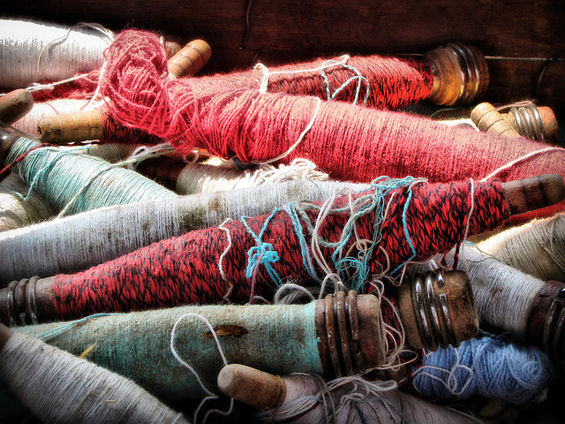
Angela Alaimo O’Donnell concludes the essay she began last week, seeking to answer the question, “What is a poet?“
My Many-Minded-Ness, or “One of These Things is Not Like the Other”
Poets are many and multiple, each unique in his or her own peculiar ways. No two of them are alike—so much so that there is no such thing as The Poet—only a poet and poets. The capital “P” singular just won’t do. Let me illustrate.
Question: What do Allen Ginsberg & John Donne have in common?
- Donne was an Anglican priest, Dean of St. Paul’s Cathedral in London, a fiery preacher who wrote erotic religious poetry and pious secular poetry. All of Donne’s life was an extended love poem to God. Ginsberg was a secular American Jew, a sometime atheist with a Buddhist bent, a mystic who saw God nowhere and everywhere at once.
- Donne was married, a happy husband and father of many children; Ginsberg was single, childless, and militantly homosexual in a culture that shunned and punished such Difference.
- Donne wrote formal verse that melded Christian symbol, wildly exotic imagery, and the dailyness of life; Ginsberg wrote free verse, based upon the riffs of American Jazz, the rhythms of the Old Testament (as transmuted through Walt Whitman and Kaddish), and Buddhist incantation.
Given these facts—a few among many one might list—there is but one honest response to the question posed above.
Answer: Absolutely nothing—except for the fact that both are poets.
In keeping with this highly individual identity each poet possesses, each has highly individual ideas about the function, purpose, and practice of poetry. There are as many definitions of Poetry and incarnations of The Poet as there are poets. This sort of dissent might be cause for despair on the part of the reader who wants a quick-and-easy definition for each of these terms—but for the reader who admires ambiguity, who loves the play of paradox, and who savors multiplicity, it is warm brownies and cold milk.
Each semester, when I teach poetry to my students, I begin this delicious conversation by passing around a page of quotations from various poets defining The Poet and Poetry. This list ranges from Wordsworth’s simple (and sexist) statement, “A poet is a man speaking to men” to Emerson’s proud (and pagan) pronouncement, “Poets are liberating gods.” In between are wonderfully presumptuous proclamations promoting the power of poetry (Shelley’s famous claim, “Poets are the unacknowledged legislators of the world”) and statements meant to temper such illusions (Auden’s admission, “Poetry makes nothing happen.”) Frost claims poetry is “a momentary stay against confusion, ” while Coleridge brings us back to the most basic of definitions, “poetry is the best words in the best order.”
Soaring from such rhetorical heights to the (supposed) depths of plain speech can be dizzying, but the journey is instructive, not to mention a great deal of fun. Each poet is right, of course, though every formulation defies the other. Forced as we are to entertain multiple images and ideas at the same time and to resist privileging one over the other, what my students and I eventually discover together is that engaging these poets in conversation about what poetry might be is a poetical act. We are exercising Keats’s concept of Negative Capability—content to exist amid “uncertainties, mysteries, doubts, without any irritable reaching after fact and reason.” Whitman gives us his imprimatur as well:
Do I contradict myself?
Very well, then, I contradict myself.
(I am large. I contain multitudes.)
There is just no arguing with poets.
Of Failure & Folly
And so I find myself in the inevitable (and unenviable) position of those poets who have come before me who failed at the task of forging a satisfactory definition of “The Poet.” Nevertheless, there is bound to be consolation even in this.
Poet and mystic William Blake once wrote, “If the fool would persist in his folly he would become wise.” Having been fool enough to take on the task, and having come this far, my hope is that I might discover some small piece of wisdom to leave you with, dear reader.
The last word on my Hit List of Tasty Poetry Tidbits does not come from a poet at all, but from a very different kind of artist, Louis Armstrong. When asked, once, by a fan of his music, “What is Jazz?” Armstrong purportedly paused and then answered, “Man, if you gotta ask, you’ll never know.”
We know jazz when we hear it—and poetry when we read it. And we know the player and the poet through the fruits of his or her labor. The proof is in the putting (or “the pudding, ” if you like a tastier version of the cliché). Taking my final cue from the Jazz Master, it seems to me that the best answer to the question of what defines The Poet—and Poetry—is no answer at all.
Photo by Wendy Piersall. Creative Commons license via Flickr. Post by Angela Alaimo O’Donnell, author of Saint Sinatra and Other Poems.
Purchase The Novelist, by L.L. Barkat now!
- Re-Inventing the Ode - March 19, 2014
- Poetry: Mirroring the Unseen - June 26, 2013
- Haiku: Pierced by Beauty - December 19, 2012
Maureen Doallas says
Armstrong has it right!
Thank you for such a fine essay, Angela. To be “many-minded” is to find one of the best ways into poetry.
Angela Alaimo O'Donnell says
Thank you, Maureen, for reading!
Yes, Sir Louis gets a lot of things right. Would that I could play my instrument of choice as beautifully as he played his–something to aspire to!
Megan Willome says
What fun to see Donne and Ginsburg side by side! It makes me want them to be together somewhere, each drinking their beverage of choice, reading and talking poetry.
Chris Yokel says
I just ran into this same issue in teaching a poetry class as well: “What is poetry?” I think we poets will be forever chasing that one
Angela Alaimo O'Donnell says
Yes, Chris–I’m sure we will . . . Thanks be to God!
Cheers,
Angela