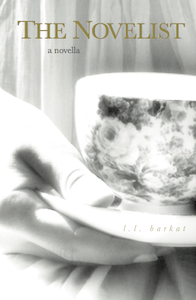
Read an Excerpt of The Novelist • Chapter 1
THE END.
She typed finality across the center of the page and closed the laptop with a snap.
What would it be this morning? She turned to her tea cabinet and opened it quietly. Maybe a green jasmine. She could tweet about it later and make Megan smile. Megan would have tweeted something about a new Earl Grey, and they would share fantasies about each other’s kitchens and tea cups. Or did Megan use a mug?
This would explain it. Why she typed, “The End.” This lack of attention to detail. Shouldn’t she know by now what Megan took her tea in? Hadn’t she read a few hundred tweets or more, about English Breakfasts and new green blends, a white tea for afternoon, and a cataloging of how many cups Megan had drunk by 9 pm? She had. Over and again, she had.
But she could not recall Megan’s imbibing-receptacle-of-choice. A novelist would remember these things. She would even be willing to research about tea, wouldn’t she? To create a believable character based on Megan? An authentic character who knew her basic pekoes from her golden tippys?
Novelists were like that. The real ones, anyway. The ones that Nobel Prize winner Mario Vargas Llosa wrote about in Letters to a Young Novelist. Flaubert, Proust, Thomas Wolfe.
She hadn’t made it past page 5 in Proust, had gotten hopelessly lost in his detailed descriptions and a vague sense that maybe he was in love with his mother. Really in love. Like maybe he would like to nurse again, but not quite like that. This could be wrong. She could have heard that somewhere and not picked it up by page 5 at all.
And had she even read Wolfe? She couldn’t remember that either, beyond what Vargas Llosa quoted, which she had just read on Monday. Thomas Wolfe likened the life of a writer to being infected by a worm that fed on his insides.
A worm?
It got worse. Vargas Llosa loved this image, had thought of it himself and was simply quoting Wolfe to say, You see? Being a writer is like having an insatiable parasite inside you.
Vargas Llosa’s worm was a tapeworm, and he had rolled out a few anecdotes about real people with real worms, including a few nineteenth-century ladies who purposely swallowed tapeworms that would eat their insides out, for the sake of social effect—along the lines of impressing the in-crowd with their stunningly slender waistlines.
She hated worms. Her own German grandmother had strung them on fishing lines, turned them loose by the hundreds in her garden, even smashed the “bad” ones between her thumb and middle finger, until their green insides popped out like a bilious pearl.
Laura put her hand to the edge of the granite countertop, feeling suddenly sick. A light sweat broke out across the back of her neck and a warmth spread through her limbs.
She’d better sit down on the floor, right here. Maybe someone would find her dead a few months from now, when her bills went unpaid and the repo guys jimmied the door.
Her laptop was plugged in, though, and the Word file was still open on the desktop—a single page of a novel she had never started, with the words “The End” typed smack in its center. As she sank to the floor, she managed a laugh. “The End.” They’d think it was a suicide note, wouldn’t they?
And there she’d be, where she was now, finally, thankfully. Cheek to the cool oak floor, having died of a worm.


Free Discussion Questions—for Bookclubs, Writer’s Groups, or Teachers
1. At the opening of the book, the main character Laura resists the concept proposed by author Mario Vargas Llosa—that a writer has “a worm.” What language and past experience does she use to resist it? Why do you think she resists? By the end of the book, has her resistance proved useful?
2. Name the various characters in the novelist. Who do you like and why? Dislike and why?
3. ‘The Novelist’ suggests that a good story will put its main character into a “muddle stage” in the center of the story. In ‘The Novelist, ‘ does Laura find herself in a muddle? If so, what is its nature?
4. Explore Laura’s description of her relationship with Geoffrey. What do we learn about Laura from it?
5. How is Laura’s relationship with Geoffrey like (or not like) her relationship to writing?
6. The book includes various writing sources, writers, and genres that Laura contemplates along the way: Letters to a Young Novelist, Plot & Structure, Mary Shelley, Murasaki and her Tale of Genji, fairytales, poetry, autobiographical fiction. What starting-points do these bring to the writing classroom or the writer?
7. Consider the appearance of the letter V. Does it add anything to the story? If so, what?
8. How is Laura like, or not like, the old woman in the cottage?
9. Why do you think Laura reads the Adrienne Rich poems to Geoffrey? Do you see her in the specific lines she chooses to share? If so, how?
10. What are some key writing lessons that Laura learns through her thinking process?
11. What do each of the characters in the book represent to a potential novelist?
12. Discuss some of the main images in the story: tea; the tea basket, screen door, sieves; colors; natural items like trees, shells, moths; temperature; cups; gateways like doors, the bridge, “keys.”
What do the various images reveal about the main character, Laura? About the writing process?
13. Consider the notions of fiction and truth used in the novel. What scenes explore it most deeply? What conclusions do you draw from such scenes?
14. Laura worries that if she writes a novel it will be all about her father. Is the story that emerges actually about Laura’s father? How do you know?
15. Do Laura’s poems serve the story? Does the story serve Laura’s poems? What would we lose if either the poems or the story were removed?
16. How long does it take for the story to take place? What writing devices does the author use to manage this time frame?
17. What is the big idea in this book?
18. Who should read this book and why?
Purchase the Book • Great for Book Clubs, Writing Groups, and Literature or Writing Classes
More on The Novelist
Steal Your Way to Better Writing, featured at Jane Friedman’s
Fiction Debut Could Help Dana Gioia’s Dream Come True (also featured at The Miami Herald, San Francisco Chronicle, Yahoo! Finance, and more