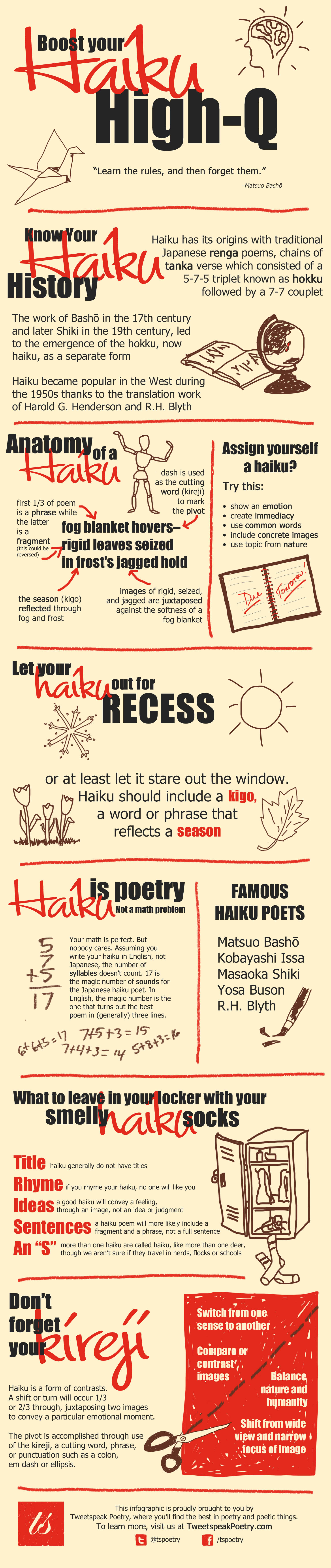
How to Write a Haiku Infographic
One of my kids found me in the midst of this project the other day, and what followed was a bit of spirited discourse over whether my assertion was true that haiku is poetry, not a math problem. He’d been taught haiku as a straight-up 5-7-5 triplet. I won, of course, because I’m the parent. And besides, I’d done the research. I laid my “You don’t speak Japanese” trump card on the desk and he left my office grumbling.
It seems when Bashō encouraged would-be poets to “learn the rules and then forget them, ” he knew there would be far more views on how to write haiku than syllables in the compact poetic form. We’ve gathered up the best advice in this helpful haiku infographic to help you Boost Your Haiku High-Q.
I have to tell you. When I read that one haiku expert suggested haiku was “not fun, ” I knew he’d never visited Tweetspeak. We broke that rule right out of the gate.

BUY ‘HOW TO WRITE A FORM POEM’ NOW!

Read related posts about writing and reading haiku.
Check out our other infographics, from how to write a sonnet to Pride and Prejudice.
Post by Will Willingham.


- Earth Song Poem Featured on The Slowdown!—Birds in Home Depot - February 7, 2023
- The Rapping in the Attic—Happy Holidays Fun Video! - December 21, 2022
- Video: Earth Song: A Nature Poems Experience—Enchanting! - December 6, 2022
Ann Kroeker says
Outstanding. I’ll pull this up in writing class next week to help launch our poetry unit.
Yes, after a grueling year of essays and research papers, we are ending the year with a unit on poetry.
Music to your ears?
L. L. Barkat says
Phew. We made an infographic usable in the classroom 🙂 This might be a first. 😉
Totally rated G, unless you count the smelly socks, which might need censorship 😉
Will Willingham says
Cool, Ann. 🙂 Hope it’s helpful. There’s actually all kinds of Haiku knowledge I left out completely. It hides a lot of complexity in its little gym socks.
Ann Kroeker says
Oh, the smelly socks makes it even BETTER suited to a classroom with teen boys! They’ll love that!
Maureen Doallas says
Another wonderful infographic. You can go into business now.
Do you know David M. Bader’s book “Haiku U.: From Aristotle to Zola, 100 Great Books in 17 Syllables”? A few of his haiku, like his take on Nabokov’s Lolita and Lawrence’s “Lady Chatterley’s Lover”, are naughty, though many are funny. Here’s his version of Jack London’s “Call of the Wild”:
Alaskan tundra –
a dog finds his inner wolf.
White snows turn yellow.
Will Willingham says
Thanks Maureen. And that might be one to look up. Sounds very fun.
Charity Singleton Craig says
You are a genius with these infographics! Just like a good haiku, infographics aren’t just about the math. Your wit makes them so amazing. I LOVE it!
Will Willingham says
Thanks Charity. And yes — Laura told me yesterday when I was struggling with a section that if I could just write a paragraph I’d probably find it much easier. The infographic model requires distilling information down to the bare essentials, much like haiku does.
Megan Willome says
Just sent this to a friend who writes & publishes haiku. She says it’s the hardest form of poetry to explain even though it’s one of the shortest.
Will Willingham says
At this point, I’d have to concur with your friend. And this really surprised me. I expected a single panel for this piece with a couple of pithy comments. Not so. 🙂
I’m tackling a longer form for our next project, and looking forward to it maybe being slightly easier to visualize, strangely enough.
The Haiku Circle says
Very cool ~ love how you put this together. Showcasing it @ The Haiku Circle ~ http://thehaikucircle.tumblr.com/
Maureen Doallas says
cherry blossoms blush —
blades of thirsty wild grasses
rising high as kites
Diana Trautwein says
Way cool, dude. Lovin’ these infographics. You’re a genius – but then, you know that already, right? All these years, I thought it was about syllable counting. Who knew??
Donna says
This is great! Made me wish I had a classroom wall to pin it on! (note to self; watch out for inadvertent rhyme or get used to sitting alone at the lunch table). 😀 lol!
sarah says
Wonderful. Bookmarked it so I too can use it with my writing class. 🙂
JT HARGROVE/TI-COO-ING says
A friend who happens to be a Brit who teaches English in Japan and China made me aware of the syllabic vs symbol count in 1987. Having failed to achieve an “A” in my 1950’s Jr High English class re not writing a proper Haiku/17 syllable, I became somewhat upset at age 44. In response to said, I avered, devised and demanded a true 17 (5-7-5) form which I call(ed) Neoku and/or AmNeoKu which allows one to write about anything…including nature and/or Shiki’s “…smokestacks and motorcycles”…(:-) Ergo: What say you about Shiki – from whom I borrowed “Cuckoo” – and “Senryu”…?
JTH/AMERICANCUCKOO
SimplyDarlene says
Even though I missed the original post by weeks, I’m sure as shooting glad to have found it now. 😉
Perhaps someone at TSP is thinking of gathering poetry infographics into a book, say with spiral binding on the top so readers can flip to the page o’ the day (or week) and stand the book, tipi-style on the table… all whilst they whittle away word count and syllable and rhyme and sound.
loanut says
Dear All,
Firstly, thanks your website this and your guidance in writing haiku in English.
Secondly, how to become a member of this site and howz about the fee ? I not find yet these informations here so thanks that you can tell me.
Thirdly, plz tell me about membership and things involve with that, for example that can post personal writing and hope that receive your comments it’s good or not yet in which part(s), can make a blog here and which your conditions for bloggers etc…
Thank you very much for your reading and your replying in details to help me.
Thanks again and God bless you all there.
Loanut.
Lin Kaatz Chary says
Wow, I just stumbled on this tonight and feel as if I’ve been suddenly given haiku wings! I’ve mostly bound myself to the rigid 7-5-7 structure which does have its merits in terms of discipline. But now I find my content has apparently been a little more rebellious than my syllables! Thanks, great piece.
Donna says
Haiku wings! Oh that’s an image that tickles me. Lin, so good to see you here, and so glad you shared that! Haiku wings. Love it. 🙂 Welcome.
Donna says
haiku wings soaring
daring the sun to loose
even one feather
🙂