Apr 282011

Marcus Goodyear is senior editor for TheHighCalling.org (sponsored by Foundations for Laity Renewal) and FaithintheWorkplace.com (sponsored by Christianity Today). His poetry has been published in Geez Magazine, 32 Poems and Stonework Journal. Barbies at Communion: and other poems, his first volume of poetry, was published in 2010 and selected as a notable book by Englewood Review of Books. He blogs at Good Word Editing.

This poem is from Barbies at Communion.


Parable of the Sower

Judgment comes like weeds
in a lawn where the mower
sets his machine so low
it scalps the grass
and makes room for ugly
broad leaf and dollar weeds
and worse – prickles and stickers
that turn the outside wild
again, a place we can’t walk
bare foot. Slip-on sandals
aren’t even enough unless
our feet calluses are so thick we can’t feel
the spines and poisons against
the sides of our soles.
But then we plow through fields
like grounded bees spreading seed,
sowing forms of life we’d never choose,
the fallen world redeemed by our shoes.

Related:

Marcus Goodyear’s interview with TweetSpeak Poetry.

Reviews of Barbies at Communion at Amazon.com.

Posted by Glynn Young Tagged with: , , ,
Mar 292011

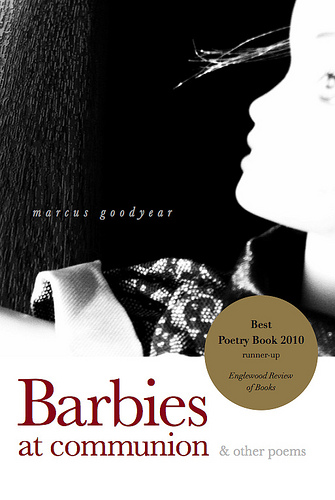
Barbies at Communion: and other poems by Marcus Goodyear has just gone into its second edition – and it has a new cover.

Published last year by T. S. Poetry Press, Barbies has received a number of great reviews and was selected as a runner-up for best poetry book of the year by the Englewood Review of Books. You can read the Tweetspeak Poetry interview with Marcus Goodyear here.

The new cover photograph is by Claire Burge.

Posted by Glynn Young Tagged with: , , ,
Jan 032011

 title=Barbies at Communion: and other poems by Marcus Goodyear was just named an honor book for 2010 by the Englewood Review of Books. The work was named a runner-up in the category of “Best Poetry Book for 2010.”

Published by T. S. Poetry Press, Barbies at Communion is about the poetry of the everyday. In late May, TweetSpeak Poetry hosted a poetry jam on Twitter in honor of Barbies. And you can read our interview with Marcus Goodyear here.

Congratulations, Marcus.

Posted by Glynn Young Tagged with: , , ,
Jul 142010

You see your young daughter playing with her Barbie dolls in church while communion is being served, and the result is a poem. You read an article about a super-collider, and a poem results (for Mother’s Day, no less). You’re cutting your lawn that’s browning in the Texas heat, and a poem results.

Welcome to Barbies at Communion: and other poems. And welcome to Marcus Goodyear.

Marcus is the Senior Editor for Foundations for Laity Renewal, which was founded by the H.E. Butt Foundation to “renew society by renewing the church.” You find most of his editing and writing work at The High Calling, The High Calling Blogs and Christianity Today’s Faith in the Workplace. He also blogs at Good Word Editing.

And you find it in his poems.

I won’t be coy. I loved Barbies at Communion. It’s about the daily, ordinary things (the super-collifer notwithstanding), and it’s because Marcus sees the poetry in the daily, ordinary things.

So Marcus took some time to talk on the phone and through email, to answer some questions I had. And he graciously responded, providing more details and insights into his own work and poetry in general.

Read the interview, and then click here to the post on my blog for an opportunity to receive a free copy of Barbies at Communion.

I have to know about the origin of the super-collider poem. And what your wife thought of it as a Mother’s Day poem.

Oh yeah, the super-collider poem. I’ve always had an amateur’s fascination with science and quantum physics. (In high school I won the state science fair in Mathematics, oddly enough.) Anyway. These days, my interest in science is limited to Nova, science fiction, and science magazines. That poem was inspired in part by an article in Technology Review from MIT.

My wife liked it, I think. It’s not really romantic, but it is kind of fun. Mother’s Day isn’t about romance, anyway. Besides. She’s used to me writing weird poems for her. One Valentine’s Day, I wrote her a sonnet about gecko toes and the van der waals force. Another time, I wrote her one about zombies. Thankfully, she tolerates my weirdness.

Where did you find a love for poetry? It’s not a “typical” (I almost said “normal”) thing these days.

About 10 years ago I was teaching high school English by day and attending grad school at night. I remember struggling through Keats’ poem “Lamia” over my lunch break one day. I had to write a two-page paper about this poem for class that evening, and I couldn’t figure out what it was about. I couldn’t find the answer

Then something just clicked. The poem didn’t have an answer. It was just an elaborate word game (about a snake woman). I still like Keats to this day, though I prefer other poems of his like the “Ode on a Grecian Urn.” His letters are cool, too.

How did you come to write poetry?

I had to teach students to read it. To make that more fun, I perversely decided that the students should try to write some too. It was really a tricky way to get them thinking about rhetorical techniques.

Through all of the crazy assignments–from the Ekphrasis poem to the N+7 poems to the traditional haikus–I had a policy that I would never assign something that I couldn’t do myself. Most of the time, this meant that I completed all of the assignments that I asked my students to complete. Sometimes, I would let them grade me. It was very scary. High school students don’t lie.

Tell us again about reading Whitman’s “Crossing Brooklyn Ferry” on Brooklyn Bridge. New York is a radically different place – at least physically – than it was in Whitman’s day. Does the poem still resonate?

I love that poem. The city has grown, of course, but it still has the same heart. It still has the same complexity. Whitman’s poem anticipates change, and embraces it. In that poem–and people should just go read it out loud to themselves–he talks about being alive in New York. That still applies.

He talks about New York being filled with people. That still applies. And the river flowing around Manhattan. That still flows.

He says, I lived here. I walked here. I rode a ferry over these waters. I swam in them. All of the changes that have happened since Whitman’s New York are superficial when compared to the one constant. People are still resolutely human.

Someday, I hope to go back to Brooklyn Bridge and read the poem aloud again while people walk by and cars drive underneath me and the boats sail underneath them. I love that poem.

The title poem for Barbies at Communion is about your daughter playing with her dolls during a church service. How did you make the connection from that to the poem? What was the spark (assuming there was one)?

For me a poem is somewhere between image and argument and story and metaphor. Sometimes I have trouble letting go of an image that has bothered me–like the image of communion with those naked dolls. As a father, I felt anxiety about my daughter in that instance. Was it okay for her to be a kid during communion? Was it okay for the naked dolls to be, well, naked? Did it bother anyone else around us? Should it bother me as much as it did?

All of that anxiety needed an outlet. The poem doesn’t really answer the problem except to embrace my daughter’s innocence. She doesn’t care about propriety because she doesn’t understand what it means to be naked. Neither did Eve before the fall. And what is Communion except a chance to reconnect with God, to find our own innocence again through the grace and sacrifice of Jesus?

So the spark, in a literal sense, was the event itself. There were Barbies at communion on Sunday, and I didn’t know what to do with them. The poem helped me think it through.

The poems in Barbies are about the stuff of everyday life – children playing, mowing the grass (even if it’s dead), stuff stored in the attic. This isn’t the poetry of academia, which seems to dominate (some might say stifle) contemporary poetry. What is it about the everyday that appeals to you?

It’s where I live! I need my life to have meaning today, not next year, not 10 years from now, not in retrospect while I’m breathing my last. If I can’t find God in the ordinary places of life, either I’m not looking hard enough or he’s not nearly as approachable as I need him to be.

This is a paradox too. God appears in all the ordinary places, burning bushes, naked Barbies, plumbing disasters. But when he does, those places become holy. Moses had to take his shoes off. That’s one reason why the formal-ness of poetry seems fitting to these images. Poetry is very formal. It’s a way of taking my shoes off and showing respect to God when I catch glimpses of him.

I wouldn’t come down too hard on Academia. They do good work. They have a lot of pressures. They need publication credits. They need to fill their journals with names that will make them look impressive. Like any profession, it’s a community of its own, with rules and relationships and networking. As someone writing poetry outside of Academia, I can feel like I’m not part of that community, but that’s really just a call to suck it up and send out more work (which I don’t do often enough because I don’t like rejection).

What I personally find so appealing about the poems of Barbies is the concrete language. Tell us a bit about your writing background – and when was it you decided you were a writer? And what’s your education background?

I was a foreign exchange student to Germany during high school, but I didn’t speak German. Pretty strange decision. I’m a talkative person, though, so I had all these words building up inside with no way to share them. That’s really when I started writing.

When I got back to the US, I took an Independent Study Mentorship under Max Lucado. He was the minister at my church, and he wasn’t quite the publishing force that he became. The youth minister ended up working with me most of the time, but it was transformational for me to have someone like Max say, “Yeah, you’re a writer.”

Now, do you really want to know where I went to school? I earned a BA in English from Texas A&M University and an MA in English from UTSA.

How did you come to Foundations for Laity Renewal?

It’s all in who you know. They were looking for an editor, so they contacted Max’s personal editor. She has been a long friend of my family and my wife’s family. She thought of me and gave me a call on President’s Day 2005. I don’t normally remember dates like that, but this one stuck. At the time, I was looking to move to a new school, change things up a bit in my job so I wouldn’t get stale. It seemed natural to cast the net a little wider and send an application to Laity Renewal. A few months later, we moved to Kerrville where Laity Renewal is headquartered.

Tell us a bit about what it is and what it does.

This sounds cheeky, but we really are all about laity renewal. That’s our primary philosophy–renewing individuals, so they can be agents of renewal in their families and workplaces, so those small groups can be agents of renewal in their communities.

We work toward this philosophical goal through various programs–youth camp, family camp, free camps, Laity Lodge retreat center, and of course the High Calling of Our Daily Work radio program and TheHighCalling.org (which includes HighCallingBlogs.com).

And how did poetry come to be one of the features at the High Calling Blogs?

Blame L.L. Barkat. She called me up one day and said, “I want to try this poetry thing.” I was a little nervous about it, and remember saying, “Nobody cares about poetry.” It’s all part of this self-loathing problem I have. But L.L. can be very convincing. She got me to agree to a test period, and it’s been very helpful in building community.

In some ways, poetry has been historically important to Laity Renewal. When you come out to Laity Lodge in the Fall, Glynn, you’ll see poetry everywhere, hidden on bathroom tiles, on stones in the fountain, on placards in the garden, carved into beams in the ceiling. Poetry is really part of the architecture of the place.

So – what’s next? Another book of poetry? Or other things you’re working on?

I just keep writing poems and stories. I’ve got ideas for another novel. I’m querying some secular agents. And I’m working with you and L. L. on the game at TweetSpeakPoetry.com. I have a lot of high hopes for that project.

Posted by Glynn Young Tagged with: ,
Jun 162010

 Here are the final four poems from our poetry jam in honor of Barbies at Communion: and other poems by Marcus Goodyear.

The Barbie Poems 6

By @mdgoodyear, @papagoodyear, @llbarkat, @memoriaarts, @arestlessheart, @lauraboggess, @cascheller, @mattpriour, @PoemsPrayers, @KathleenOverby, @togetherforgood, @gyoung9751, @mmerubies, @jamesrls, @doallas, @Dancinbutterfly, @moondustwriter, @mxings, @Jezamama, @MarisaLopezzz, and @TchrEric; cameo appearances by @hiscrivener and @duane_scott; edited by @gyoung9751

Barbie and Her Pink Bible

I like pink
in petunias
dahlias, roses—
not so much
clinging to my body
in silks, linens, cottons.

I like pink too.
Not because
of Barbie but despite her,
to spite her,
my imperfect non-plastic self,
sporting her signature color.

Barbie would like my
2 pink Bibles
the best. I would be
her favorite.
Yet I thought Barbie preferred the
RSV — or was that the SUV?

Thou shalt not covet thy Barbie’s
King James ass.
Could Barbie one day be
the antichrist? Would the
antichrist wear pink? Or 666
on her high heeled shoe?

Barbie’s Medical Issues

In her 50s now, Barbie discovered
Arthritis. I would buy RA Barbie
with her crooked hands and
bad knees and pink bottles of NSAIDS;
I could relate to that.
Barbie had multiple personalities,
I guess. She did things every girl
wanted to do when she grew up.
Barbie is so ADHD. She cannot stick
to a single career. It is all pretend,
all real, all weird — us and them, she
and I, and him and her — trying on
this and that.

The Complexities of Barbie

Growing up, only boys in the
Neighborhood, brother and I,
learned more from the girls
with Barbie in their pockets
than we should know; poor boys
learning from pocket stuff.

Complex, these dolls
that make us dream
and give us roles to play
when we are young,
to grow old and receive
our scorn.

Barbie, like computers today,
could perhaps only be
as stupid as the
ones who formed her. Are we
embarrassed by our youth
once we know what is possible?

Maybe someday we will solve the
great mystery of Barbie. I wonder
what America would be like if she
had never existed. She is who you
want her to be; she is who I wanted to be,
to be rather than to appear.

Was Barbie a Poet? Two Views

Barbie could not spread the
fingers on her hands to grip a
pen – to type – to write. I do not
want to be her. Perfection.
Boredom.

Barbie never once wrote me a poem.
What made me think she ever loved
me? Yet I hear my daughter learning
love in her room, whispering sweet
nothings between bits of plastic.

Why do we fear the day when all
children learn this fabulous truth of
what lies under these clothes – bare
beauty, nothing to scare, only caress.
it is then that we have to admit the
truth of children growing up,
fabulous or not.

She drinks green tea, eats
hand-milled-floured scones, and
dreams of her youth at communion,
head first…in a coffee cup, giving voice
to something more beautiful than she
in a voice her own. We all learn through
other faces, other voices.

She did write.
She did pray.
She did love.
When we were young
we heard it all.

Posted by Glynn Young Tagged with: , ,
Jun 162010

We’re still rolling with the Barbie poems from the last poetry jam, and there are a few more to come after this. Here are another eight poems from our poetry jam in honor of Barbies at Communion: and other poems by Marcus Goodyear.

The Barbie Poems 5

By @mdgoodyear, @papagoodyear, @llbarkat, @memoriaarts, @arestlessheart, @lauraboggess, @cascheller, @mattpriour, @PoemsPrayers, @KathleenOverby, @togetherforgood, @gyoung9751, @mmerubies, @jamesrls, @doallas, @Dancinbutterfly, @moondustwriter, @mxings, @Jezamama, @MarisaLopezzz, and @TchrEric; cameo appearances by @hiscrivener and @duane_scott; edited by @gyoung9751

Barbie and Breastfeeding

I watched my best friend nurse her daughter
last week, and she is getting no sleep. She
is a real woman with real breasts that feed.
They seem so perfect; make me seem so small
and flabby but I wonder if they are as empty
as Barbie on the inside. I am afraid of such
words and I a nursing mother – not a Barbie.
Do not be afraid, goddess life-giving mother.
Nipple is a word that feeds your child. Nipple
is a word that God created. Nipple gets all
the attention…

And we wonder if Adam named the nipple
like he named the other animals. So I wonder
if God knew the word before He formed the
woman or the man or the Barbie? Word
aside, God made the nipple and the breast
and the milk that feeds the child. Where are
these nippled Barbies? Our play with sanitized
nudity was safe enough to let us sleep easy.
Poor Barbie has no nipples, no way to hold her
child to her breast and feel the nourishment
let down into his body.

I am sure Barbies also slept 8 hours at night,
though her breasts were always hard as rocks.
Get your hands away from my body. It is real.
It has curves and nipples and hair and freckles.
It will offend you, brother.

Barbie’s Easy-Bake Oven

Barbie needs an Easy-Bake oven.
We buy easy bake for our kids who apply food
network logic to create Battle Easy-Bake.
Mom would not buy me the Easy-Bake oven.
She bought one for my sister, years later;
I am bitter over such injustice.
No sister, no easy bake, no oven, no lessons in
Plastic; everything real, leaving blisters and scars.
No Easy-Bake oven, no easy way out; exploded
mess on glass frozen in time, failure not forgotten.
I want an Easy-Bake oven,
and a kitten.

Barbie’s Scarves

I remember making paths from scarves in
the living room; it was as much fun as the
Barbie play and without all the plastic nudity.
We wonder but 99 out of 100 of us are afraid
to delve mysteries, quiet words, nourishment,
and I am 1 in 100 who owns no piece packed
girlhood away in 6th grade, crushing on Ken
who was too old for me anyway. My Barbie
was a slut. I think I learned this watching
soap operas with my mom. We had a
babysitter named Barbie, a friend really,
an adopted aunt much better than a hard
plastic doll. I wanted a New Kids on the Block
“action figure” to date my Barbies.
I had a Wonder Woman Barbie.
I had Parisian Barbie: Catharine Deneuve,
Chanel #5, April Fools, enchantment.

Barbie and the Marketing of Pop Culture

We are lost in the pop gospel,
swimming in the commandments
of marketing. What poet has ever
been made into a Barbie, though?
I think that I am safe. German when
she began, or perhaps just a Viennese
model. Magic lasso, tell it true: was
Barbie a cheap woman or a lost soul
to be/pitied?
First commandment of marketing:
thou shalt always buy (something).
Second commandment of marketing:
Many a lie is said in truth
Thou shalt covet. Thou shalt worship.
Thou shalt desire the plastic sweat of dolls.
Thou shalt not kill stale marketing campaigns.
Stale turns, stale thoughts, marketing gone
mad in a world already crazy with a donut
hole and a corvette, dangerous Dior.

If They Made Me Into a Barbie

If they made me
into a Barbie
I would laugh
too loud
burn the muffins
lose my right to wear
pink.

If they made me a Barbie
I would hope to be a
red-head
so I could wear blue
since pink would clash with
me.
Barbie has no soul.

Barbie’s Pink Motorcycle

I want a motorcycle
maybe even a pink one
not because of Barbie.
I just like pink.
Pink girls who ride
motorcycles cause accidents.
Pink motorcycles,
Mary Kay road hawgs
I would rock a pink
motorcycle.

Posted by Glynn Young Tagged with: , ,
Jun 102010

We have eight more poems from our poery jam to celebrate Barbies at Communion: and other poems by Marcus Goodyear. Looking at the remaining tweets to edit, I expect two more posts here for The Barbie Poems.

The Barbie Poems 3

By @mdgoodyear, @papagoodyear, @llbarkat, @memoriaarts, @arestlessheart, @lauraboggess, @cascheller, @mattpriour, @PoemsPrayers, @KathleenOverby, @togetherforgood, @gyoung9751, @mmerubies, @jamesrls, @doallas, @Dancinbutterfly, @moondustwriter, @mxings, @Jezamama, @MarisaLopezzz, and @TchrEric; cameo appearances by @hiscrivener and @duane_scott; edited by @gyoung9751

The Dirt on Barbie

Does she know how to play,
dirty fingernails, sand in her toes?
Was there ever a Gardener Barbie
digging manicured hands in cool fresh dirt?
She could have had a pink watering can,
a magenta spade.
Hon, your feet must hurt at the end of
the day – high arches a pain.
I seldom played with Barbie once she
was dressed and groomed and her
house was ready for the game.

Whither Ken?

Everyone always thought a bit less of
Ken, who nearly always was shrifted
short in accessories until he rebelled and
donned a polyester sweater, and grabbed a
guitar to serenade, “O heck, it’s up to her neck.”
But I had a crush on Ken all my life until I
married the one who wasn’t Ken, and I learned to
think less of beefcake. Ken can serenade
Enchilada Barbie.

I always suspected Ken of being odd. Perhaps
it was the purple leather and mesh vest and the
gold earring on the one, and then there was the
beefcake and the whole enchilada, ever elusive,
left to arches of pain and bridges to nowhere.
The Ken at my house dated Midge. I always liked
Her best. If your Mom knew, they would go
shoppingfor beef, marry men.
Would that have assuaged her?

Barbie’s Not-Ken

My younger brother had GI Joe,
friend of Barbie, nemesis of Ken.
GI Joe has scruff; a wild-at-heart
man to stay instead of run. I was too
old for GI Joe; I almost said alas.
Strong silent type, that Joe,
love that camouflage, always
playing hard to get, um, find. Oh yes,
it was perfect. Who needs Ken?
Ken was a kind of pallid sturgeon;
GI Joe shot people, but my military
dad never let me have GI Joe.
And the cartoon planes only exploded
after ejection.

Career-Changing Barbie

With all your different looks and
Professions, I have a question:
Are you schizo??
Oh where is that little red purse?
I want to be the nurse
but, first
I will be the bride.

Barbie was right. Math is hard.
Oh, I think Barbie
totally knew the math,
39-21-33, a math that will always
be beyond me. Her math gives
me a backache.
Gave her one, too.

Impossible Stupid Barbie
measurement. Like anyone
can get larger in one area and
not another without surgical
assistance. Dog Chew Barbie.
Hamster-hair Barbie, always
undone in inconvenient places

And Then There was the Dream House

My boys want me to build with
Legos. And Dad prefers Legos.
I’d prefer the Barbies, the Dream House,
that shocking pink construction, to
play pretend with sand castles and
real cake. I liked folding scarves into
rectangles and using them as beds for
Barbie and her family. Boxes became
furniture and doll houses for a mussed up
doll, worn out with loving. Quilts are like
that; to keep us warm, it takes loving to
become real.

Old wooden crates? Rooms with a
view of what? Barbie dream house not.
But wallpaper books are for decorating;
she appreciates the good things, neat
house, no mess to create fun, no art to
decorate the heart. It wasn’t for me to dwell
in. Inside my head were many rooms; mother
and father never smiled like Barbie and Ken.
To put on rooms was nothing; we just put it on,
no cost to us. Or her. The box is the
thing. But the demolition was the
devious intention. 

What About Skipper?

Skipper was too flat-chested for
my breast-jealous self. I had a collie
named Skipper; my best friend had a
collie named Skipper. How strangely
perfect.
Skipper was my favorite; she was pretty
and young and Barbie hated her for it.
She could not bend her legs. I do not
want to live without feeling my
body move.
Was Midge the redhead? I liked her too.
Yes, Midge. All little girls had a Barbie
but the one I love.

What Barbie Was Like

My Barbie was silent. So were
my parents when they considered
the Barbie budget. I could talk enough
for all my Barbies; they needed no
voice but mine.
The pain of smile did not reach her eyes;
her fingers, never soft to the touch,
always cold and recoiling. Communing
as façade, girl knife in back, smiling pink
lips drink communion blood. Those
beautiful eyes never reflected the
stars, only your wardrobe.
True beauty shines within.

Barbie Drinks Tea, Too

I never liked tea
till I went to China.
Learned to drink it there
as different among those
black heads
as Barbie would have been.

Posted by Glynn Young Tagged with: , , ,
May 262010

We had our poetry jam on Twitter last night, and this time we did a kind of “event” around Marcus Goodyear’s newly published collection, Barbies at Communion: and other poems. So, yes, it was a Barbie-themed party, and it was wild.

For the last three poetry jams, we’ve been featuring a new “tool” or Twitter application developed by Matt Priour. You can see it at the main TweetSpeak URL. You log in under your Twitter account, and then post in the designated box. Poetry jam prompts appear in the box above the tweeting box.

Electronically, what happens is this: you log in, you enter a tweet and hit the tweet button, and then the application sends the tweet to the Twitter data base (a kind of “registration process”) and then back out again to the posted tweets list. It can take up to 10 seconds to complete the process. While you’re waiting, other tweets are appearing, you respond with a new one – and, as you might imagine, the pace can get frantic and you can easily lose your way.

But you don’t have to use the tool (we call it TweetSpeak Party); you can use Twitter, HootSuite, TweetDeck or any other similar application, and your tweets are included as long as you include the #tsptry hashtag with your tweets.

I used TweetSpeak Party exclusively last night. And while the 10-second delay could be perplexing, with poetic contributions streaming in and from all directions, I found myself focusing on a few and then following and responding to those. A few participants had trouble with the tool, and then trying to keep track of everything with other applications like HootSuite or TweetDeck. I was also watching the tweets via TweetDeck, and found a few that weren’t showing up in the TweetSpeak Party posting box (although they all did show up in the data base Matt created to collect all of the tweets – 1,080 tweets strong). And a few had some technical trouble with either TweetSpeak Party or their regular Twitter application.

Matt’s been working on a new application, one that can be independent of Twitter or other applications and happen within the framework of TweetSpeak Poetry itself. We’ll keep you up-to-date on progress.

Now the hard part starts – the editing of the tweets into poems. The process itself deserves its own blog post, but what essentially happens is this: I read through all of the tweets as a group several times. I then highlight what are obviously related tweets. Those are copied and pasted into a Word document, then worked over to fit them with each other in what can range from 15 to 35 poems. This usually happens over a period of about a week.

For the Barbie poems, I’ll have an introduction, which will include the usual pre-party online discussion and a couple of links provided by the poet/author himself to inspire the participants. Although I’m not sure how inspirational Barbie Enchiladas actually are.

Related:

Kindle and print versions of Barbies at Communion are available via Amazon. You can also order a print copy signed by the author via Paypal, linked from the book’s web page.

Want to party with the poems all the time? Take a button, if you like…

barbies button

Posted by Glynn Young Tagged with: , , ,